

What is Ambition?
How psychology researchers define ambition, and why it matters


Ambition is a fascinating topic. In some ways this intrigue might well have contributed to my choice of career in Coaching and Talent Development. Few other jobs put you in a position to engage with, learn from, and help so many wonderfully interesting and ambitious people.
But, oddly enough, I seldom hear those people describe themselves as ambitious. If they do, they’re quick to qualify, or substitute some euphemism in its place. They might describe others as ambitious, but more often than not, there is an implicitly negative connotation. So, what gives?
It turns out that ambition occupies a strange place in our cultural psyche. On one hand, it is celebrated as the engine of progress and success. But on the other, it is shadowed by centuries of cautionary tales, moral warnings, and deeply ingrained beliefs about who should strive, how much, and for what reasons. This tension creates an odd dynamic: we value (and benefit from) the fruits of ambition, but we hesitate to fully embrace it.
This article is the first in a series exploring this odd phenomenon, along with the nuances, contradictions, and implications of how we think about ambition. We’ll examine how it shapes our choices, our lives, and the lives of those we care about—and how we might, if we so choose, harness it to its fullest potential.
Complacency rarely makes history. It rarely makes anything, in fact.
On the other hand, tomes are written about, and by, ambitious people.
For example, Cornelius Vanderbilt's most popular biography exceeds 700 pages. It recounts the American business magnate's journey from lowly, brawling sailor to steam boat captain to Wall St. powerhouse to railroad tycoon. Throughout his epic and controversial entrepreneurial journey, Vanderbilt “survived fistfights, boiler explosions, a train wreck, heart trouble, Nicaraguan rapids, exposure to tropical diseases, Atlantic storms, and wagon smashes." When he died in 1877 at the age of 82, Vanderbilt had amassed a dynastic fortune of ~$100 million (or $1 for every $9 in existence at the time). "Commodore" Vanderbilt was a swashbuckling, ass-kicking capitalist extraordinaire, fueled by a marked lack of regulation, unbounded opportunity, and unbridled ambition.

How ambitious are you? If you could snap your fingers and become as ambitious as The Commodore, would you dare?
These questions are hard to answer. Ambition is one of the most pervasive, yet polarizing and misunderstood concepts in Western culture. In Ambition, A History: From Vice to Virtue, Yale's William Casey King declares that ambition is "widely considered to be a strong component of the American national character and intrinsic to the American mythos." However, popular conceptions of ambition are less straightforward. As Psychiatrist Neel Burton explains, “in the West, ambition is lauded as a precondition or precursor of success, even though the Western canon itself tends to fall against it."
There are countless euphemisms for “ambitious,” from “driven” to “aspirational” to “high-achieving.” Why not just say the word, if that’s what we mean? Partly it’s because, as Burton observed, the concept has been trounced for millennia in literature, history, philosophy, and theology ("God detesteth ambition" ― Geneva Bible, marginal note). Archaic warnings against ambition abound, for example, in the Myth of Icarus1: Failing to heed his father's warning, Icarus flies too close to the sun and melts the wax on his fabricated wings. He falls into the sea and drowns, becoming an enduring warning against hubris and untempered ambition.
However, there is a conveniently neglected counterwarning: Icarus was also warned against flying too low, for fear that the ocean mist would clog his wings and send him plummeting all the same.

Like Icarus, our relationship with ambition is complicated. We are stuck in a state of cultural cognitive dissonance, grinding between contradictory beliefs about our own innate striving instinct. On one hand, it drives us. It dictates how we spend much of our lives and many of the decisions we make along the way. On the other, for many people it engenders a sense of shame, resentment, or anxiety (see: crab mentality, the law of Jante, tall poppy syndrome, impostor syndrome). But the consequences of this bizarre tension cannot be overstated. Our muddy misconceptions about ambition may very well act as an artificial limiter on human potential.
What is Ambition?
First, let's put aside for a moment any preconceived notions and establish a clear definition of ambition, uncolored by ideology, propaganda, or popular culture. If we can understand ambition at its core, then we have the scaffolding necessary to embrace, cultivate, and channel it, hopefully in the most positive conceivable direction.
"On the Value of Aiming High: The Causes and Consequences of Ambition" by Timothy A. Judge and John D. Kammeyer-Mueller has become the de facto foundational source for empirical information on ambition2. The authors recognized ambition as a "pervasive yet poorly understood" concept and the subject of myriad and often extreme references throughout time and across domains. They identified the need for "clearer definitions and more comprehensive considerations of, first, the causes and, second, the consequences of ambition." The ensuing study provided unique insights into the ranging antecedents of ambition, the significant outcomes it helps produce, and the role it plays in mediating the two.
After sifting through a litany of existing descriptions, the researchers proposed one concise, integrated definition of ambition:
"Ambition — the persistent and generalized striving for success, attainment, and accomplishment."
They distilled ambition down into its core, unbiased components, each of which we'll unpack in a moment. But before we dive deeper into how ambition is defined, let's discuss what exactly it is. A personality trait? A superlative? An affliction?
Middle-Level Trait
The authors posit that ambition is best understood as a "middle-level" or "Level II" trait. It's not a broad, first-order personality trait like, for example, extraversion. Ambition is a midlevel trait because it exists where certain personality traits intersect with specific contexts, influences, and perceptions of the world3.
To risk oversimplifying it, we can imagine core personality traits and preferences as "nature," context as "nurture," and middle-level traits existing in between.
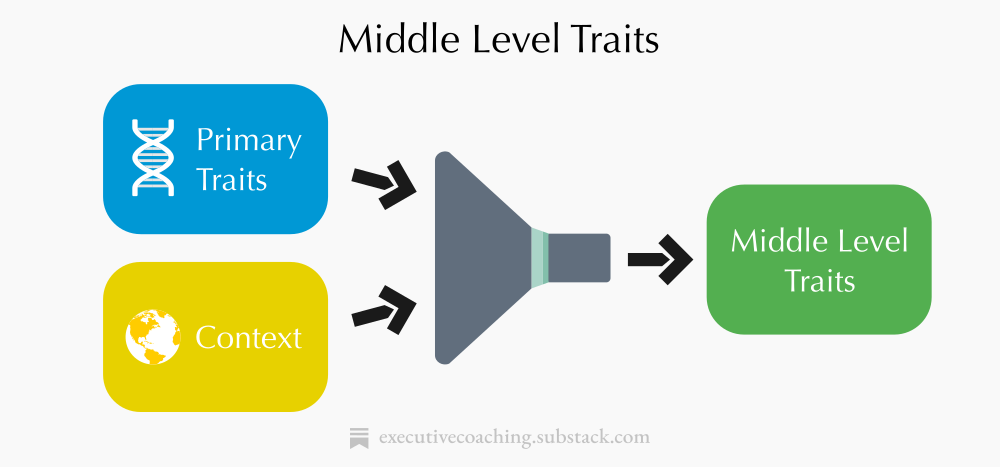
Middle-level traits give concrete forms to the abstract dispositions of personality. They are what people do with their personality traits in a given context. As we'll explore, because of the influence of one's environment on middle-level traits, we can expect them to manifest themselves differently based on a person's setting, upbringing, beliefs, and self-perceptions.
Persistent & Generalized
Like all middle-level traits, ambition has two important qualities: it is persistent and generalized.
In the 14th century, the Buddhist monk Yoshida Kenkō observed that "ambition never comes to an end." Centuries later, evidence from longitudinal studies showed that ambition does, in fact, persist over long portions of an individual's life. Someone with higher levels of ambition will generally remain that way. Naturally, this begs several important questions: If ambitious people stay ambitious, are unambitious people "stuck" that way? If someone is bogged down by inertia, do we have a chance igniting the lasting flame of ambition, or can we, at best, offer them mere flickers of motivation?
Second, rather than pick and choose specific domains, ambition generalizes across contexts. So broadly speaking, if you are ambitious, it will show up in many different areas of your life. Chasing accomplishment and striving to ascend hierarchies will be your default mode of operating, for better or worse, regardless of the endeavor. An obvious, albeit extreme example is Arnold Schwarzenegger — to illustrate, let's look at an abridged version of his life resume:
Weightlifting champion (as a young teenager, no less)
Multiple time bodybuilding world champion
Real estate millionaire
Movie star (and at one point, Hollywood's highest paid leading actor)
Governor of California
Best-selling author
So we're talking about something more than fickle, fleeting motivation. Ambition is a "habitual level of striving." But to what end?
Outcome-Oriented
Unsurprisingly, ambition is eminently outcome-oriented. According to the authors and consistent with many dictionary definitions, a cornerstone of ambition is the desire to achieve a certain status, rank, or level of success.
In a vacuum, pure ambition motivates an individual to value and resolutely pursue rewards, results, and recognition, irrespective of what is required to obtain such outcomes. By default the trait is neutral, but because human beings place such an emphasis on not only what is done, but how it is done, it's difficult to tolerate the moral ambiguity of ambition's outcome-fixation. As a result, it is so frequently prefaced with some type of loaded modifier (everything from ethical and valiant to blind and selfish) or described in an emotionally-charged way (e.g. "Ambition is but Avarice on stilts and masked." - Walter Savage Landor) that we assume the trait has some inherent valence, which is simply not the case.
Ambition is achromatic. It is what we make of it. But importantly, it orients us toward some distant vision. It motivates us to make sacrifices in the present in hope of a better future. And it is powerful.
Ambition Produces Better Outcomes
While ambition is not necessarily "good" or "bad" in an ethical or psychological sense, it is, however, inherently potent. The researchers hypothesized and demonstrated that ambition is a mediating factor between the "more abstract and general dispositions and characteristics" we've discussed already and "extrinsic indications of success." In the real world, higher levels of ambition consistently equate to better performance and higher levels of attainment. Crucially, this demonstrates that ambition potentiates one's personality, talents, and intelligence, thus producing better outcomes. This gives credence to the old saying: "Intelligence without ambition is a bird without wings." Ambition allows us to soar.
In the most rare and extreme cases, when integrated into the right (or wrong) system, history shows that ambition plays a role in producing both the best and worst of humanity. But for the overwhelming majority of people, we can safely consider it a form of neutral potential, a mere ingredient in the inscrutable composite that is a human being. One which helps chart the magnitude, but not the precise destination, of our desires. And a forceful one that, in itself, produces higher levels of output and performance, contributes to the attainment of one's goals, and helps maximize human potentiality.
What Ambition is Not
In trying to understand ambition and where it comes from, it's important to explore some relevant but distinct psychological concepts.
Aspiration — Whereas ambition persists over time and generalizes across contexts, according to the researchers, aspirations have specific targets (e.g. "I aspire to obtain my college degree"). Thus we can conclude that all ambitious people have aspirations, but not all those with aspirations are ambitious.
Conscientiousness — We'll dive into conscientiousness in more detail later, but in summary it is a broader, more foundational personality trait that can include ambition, but also encompasses things like dependability, dutifulness, orderliness, and more.
Desire for power — Ambition is often falsely equated with a desire for power for its own sake. However, ambitious people are typically not motivated by power itself, but by the outcomes it enables, such as achievement, recognition, or the pursuit of meaningful goals. Power, in this sense, is a tool or byproduct of ambition rather than a core driver. It reflects how someone wields their status or position once they attain it, making it related to, but fundamentally distinct from ambition.
Achievement striving / motive — While closely related to ambition, achievement motivation represents not only an individual's success-orientation, but their desire to overcome obstacles and become skilled and competent at tasks in the process. (To me, this functions like some sort of research-friendly surrogate for ambition, conveniently stripped of the morally gray stuff.) An ambitious person, on the other hand, is more desirous of the rewards and outcomes this competence produces. It's easy to paint a false dichotomy here: Ambition is bad because it only cares about the ends, and achievement motivation is good because it cares about the means. In reality, achievement motivation often fuels ambition, and ambition frequently enhances achievement striving. It’s rare to find one without the other.
Where Does Ambition Come From?
We'll wrap up by exploring the factors that help dictate the dimensions of our ambition and how it shows up in the world.
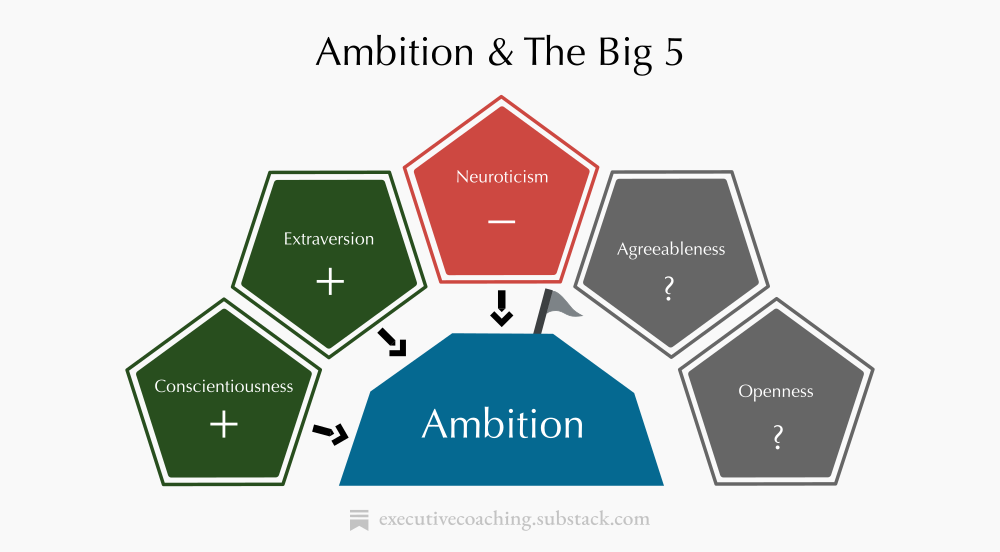
Psychology's most popular model of personality is the Five Factor Model aka "The Big 5" or "O.C.E.A.N." The Five Factor Model includes five fundamental personality traits: Openness, Conscientiousness, Extraversion, Agreeableness, and Neuroticism. Each dimension is inborn, globally-relevant, relatively stable across one’s lifespan, and exists on a continuum.
While ambition doubtlessly interacts with each trait, the aforementioned research focuses on just three:
Conscientiousness
One antecedent of ambition is the trait conscientiousness. Conscientiousness is associated with qualities like prudence, dutifulness, and the ability to delay gratification. Conscientious people are drawn toward success goals based on their tendency to be diligent, motivated, and goal directed. They set goals more frequently and show higher commitment to their goals. Of the Big 5 personality traits, conscientiousness is the strongest predictor of ambition.
Extraversion
It frustrates me to no end when people oversimplify extraversion to whether someone “likes parties” or “gets energy from groups.” Extraversion is much more nuanced, and better defined as the degree to which a person is oriented toward and draws energy from their external world.
Sure, extraverted people tend to be more sociable and outgoing, but they are also more energetic, enthusiastic, action-oriented, and assertive. Research shows a strong relationship between extraversion and striving toward social position and worldly success, as well as confidence within domains of occupational performance and achievement. Thus, it unsurprisingly proved to be another significant predictor of ambition.
Neuroticism
If someone is highly neurotic in a technical sense, they are more sensitive to negative emotion. Neurotic individuals are more likely to be doubtful, anxious, and pessimistic about the future, and thus researchers hypothesized that ambition would be inversely correlated with ambition. The evidence supports this idea, although the relationship was weaker than anticipated. So the more neurotic someone is, the less likely they are to be ambitious, but it by no means smothers their ambition in the same way that a lack of extraversion or conscientiousness theoretically would.
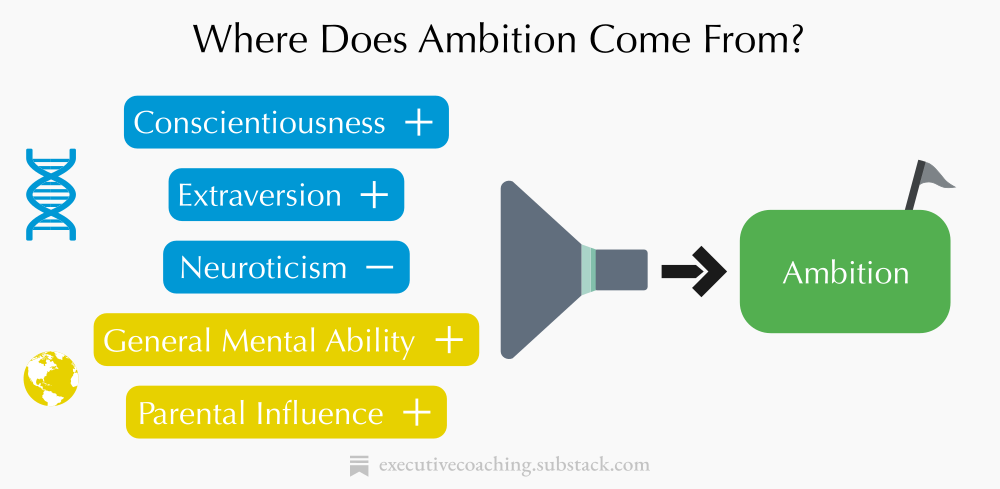
Outside of personality, the research explores two more factors that reliably predict ambition: general mental ability and (surprise!) our parents.
General Mental Ability
"Intelligence" is an incredibly loaded and controversial concept in psychology. Researchers explore intelligence from just about every conceivable angle, but one frequently referenced construct is General Mental Ability (GMA). We can think of GMA essentially as the brain's horsepower — our ability to handle "all types of intellectual tasks." This mental ability influences and sustains our ambition because, according to the researchers, success begets success.
Intelligence can create a positive feedback loop: Individuals with higher levels of GMA will be accustomed to achieving success relative to their goals, for example in educational contexts early in life. Their early success encourages them to set more lofty goals. Thanks to their intelligence and ever-growing confidence, they achieve those goals, and continue to dial up the ambition level for future goals. This was not only demonstrated in the research, but predicted earlier by Albert Bandura's social cognitive theory, and in particular, his concept of self-efficacy4.
Parental Influence
Unsurprisingly, our parents play a huge role in influencing our ambition. The researchers propose several mechanisms of action:
First, because children look to their parents as role models, if parental figures set and achieve lofty goals, their child will strive to emulate them. Second, and in accordance with the aforementioned social cognitive theory, a child with successful parents might think, "If they can do it, so can I," and thus feel more capable of enacting their ambition. Additionally, one's parents may explicitly communicate high expectations. As explained by the authors, "families act as powerful socialization agents, shaping children's values with respect to occupational and educational success. Parents who value and achieve success in their own lives are likely to inculcate their children with these same values." Finally, because there is substantial evidence demonstrating the genetic transmission of personality traits and intelligence, the authors propose the possibility that "ambitious parents have children who are genetically predisposed to be ambitious."
These contextual ("nurture") mechanisms - emulation, enablement, and expectation-setting - had roughly the same influence on individuals’ ambition as the inborn and genetic ("nature") variables.
We’re Just Getting Started
We've explored a few key questions about ambition, as well as a relatively small selection of sources. But in doing so we've opened Pandora's box5 — just this short analysis spawns countless questions and potential implications:
How did ambition get such a bad rap? Is it justified?
How can we increase the likelihood that our ambition will result in actual results and positive outcomes?
How does ambition influence our choices in career, lifestyle, etc.? How do we avoid allowing it to steer us down the wrong path?
What is the “right” amount of ambition?
What does the “dark side” of ambition look like, and how do we prevent it?
I have all this ambition. What do I do with it?
I have no ambition. Where do I get some?
I achieved all these things, but I don’t feel any better. Now what?
I hope you'll join me in exploring each of these questions about ambition, and many more. Subscribe to my newsletter to stay up to date as I release new articles, pose new questions, and discover new research — click here or enter your email below:
Enjoy this article? Share it with a friend:
A version of this article was originally published on my now-defunct blog BringAmbition.com on Jul 23, 2021.
Unless otherwise noted, the statements in this article are supported by this research. Where there are external references for additional context or color, these are notated or hyperlinked.
Other examples of middle level traits include: integrity, empathy, adaptability, creative disposition, etc.
The relationship between ambition and self-efficacy is fascinating, and I could go on and on about this topic. But we’ll save that for future posts.
Maybe a more appropriate Greek mythology-inspired idiom would be “unfurled Icarus’ wings”